

How Ethernet is Poised to Expand in the Entire AI Networking Landscape
Introduction
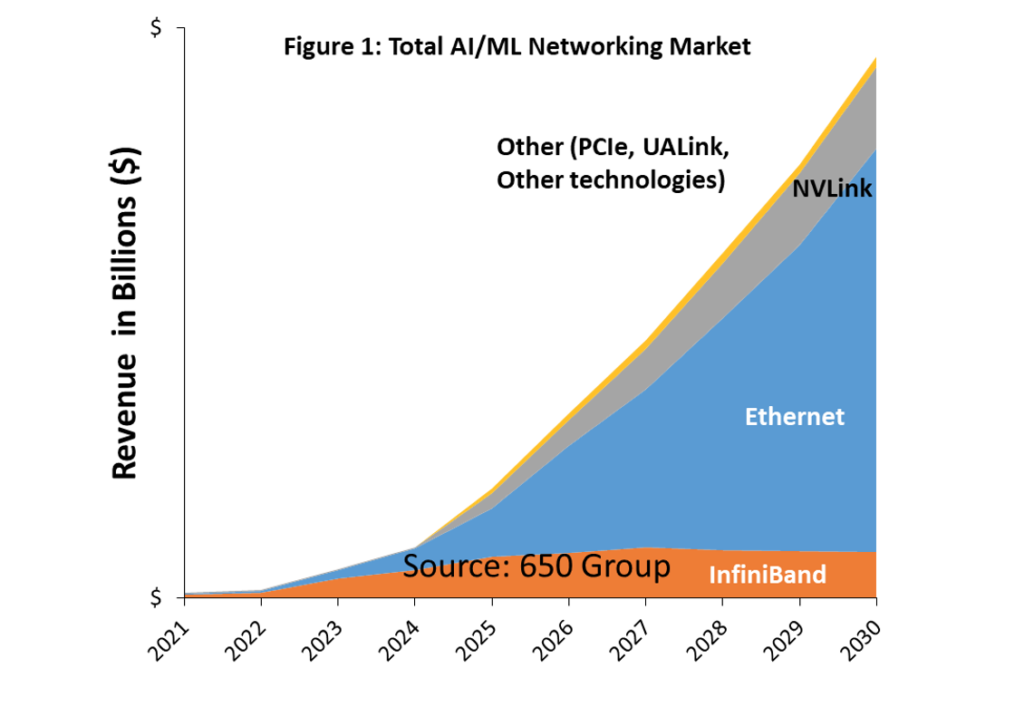
In the rapidly evolving world of AI infrastructure, the debate between scale-up and scale-out architectures has shaped market dynamics. As we enter 2026, Ethernet’s trajectory suggests it will surge in Scale-Out and move from proof-of-concept to production in Scale-Up. This blog explores the definitions, market shifts, and implications for vendors and startups, drawing on our latest research. We’ll also incorporate optics into the discussion, as co-packaged optics (CPO) could expand addressable markets significantly. In its totality, data center networking is poised to approach and potentially exceed $200B (Figure 1) a year by the end of the decade.
Definitions
Co-packaged Optics (CPO): Today, pluggable optical modules are widely used in data center networking switches to provide the reach required for large-scale AI clusters. As bandwidth and data rates continue to increase, however, pluggable optics face growing challenges, including higher power consumption and signal integrity limitations that constrain link budgets. CPO addresses these issues by integrating optical interfaces closer to the switch silicon, enabling higher bandwidth density, lower power consumption, and improved signal performance while maintaining required reach.
Scale-Out: This architecture horizontally expands computing by adding more servers or racks, connected via low-latency fabrics like InfiniBand or Ethernet. It’s ideal for distributed workloads, emphasizing east-west traffic, congestion management, and scalability. CPO will start in scale-out in meaningful volume in 2026.
Scale-Up: In contrast, scale-up vertically integrates resources, allowing GPUs to directly access each other’s memory, effectively creating a “super GPU.” This boosts performance for tightly coupled tasks but requires ultra-high-bandwidth interconnects like NVLink, UALink, or emerging Ethernet variants. In the longer term, this will be the larger market for CPO.
Scale-Out: Ethernet Set to Surge in 2026
The market has spoken decisively on scale-out: Ethernet will dominate. Our forecasts show AI scale-out Ethernet revenue surging to over $100B by 2030, driven by its cost-effectiveness, interoperability, and ecosystem maturity. InfiniBand will remain strong, but Ethernet’s momentum, fueled by the Ultra Ethernet Consortium (UEC) and the need for unified fabrics across accelerators, positions Ethernet to be the majority of future growth.
Factoring in optics, the picture expands. Pluggable optics at 800G and 1.6T, plus emerging CPO, could exceed 50% of the annual switch revenue by 2030. CPO integrates optics directly with switch ASICs, reducing power and latency, potentially addressing the whole scale-out market. CPO will consume a greater portion of the scale-out market each year.
Scale-Up: A Bifurcated Market Begins to Consolidate
The scale-up market has bifurcated sharply. Today, almost the entire market is served by NVIDIA’s NVLink. But while Nvidia dominates the accelerator market share from a revenue perspective, in terms of unit volume, many alternative GPU/XPUs require robust networking fabrics as they look to expand beyond a single server. This is what creates the non-NVIDIA scale-up opportunity for startups as well as for Nvidia’s NVLink Fusion.
UAL vs. SUE
For AMD and hyperscaler in-house XPUs, technical options boiled down to Ultra Accelerator Link (UAL) from AMD and Scale-Up Ethernet (SUE) from Broadcom. UALink leverages a PCIe-like memory semantic protocol with fixed-size frames. The UALink Consortium, including AMD, Intel, and others, aimed to standardize it for broad adoption as a counter to NVLink.
Broadcom wanted to leverage its massive investment in Ethernet chips, such as the Tomahawk series, and developed SUE as an alternative to UAL. SUE uses variable-size Ethernet packets, developed by Broadcom and submitted to the Open Compute Project (OCP). It promises flexibility for diverse workloads and leverages a mature Ethernet ecosystem.
Several startups emerged targeting this non-NVIDIA space, developing silicon, and switching to support UALink and Ethernet. Some startups started developing UAL switches and others dual-protocol solutions that can serve either a UAL or Ethernet market. However, hyperscalers, eager to ship rack-level products in 2026, turned to Broadcom’s Tomahawk 5 Ultra (T5 Ultra) and Tomahawk 6 (T6) Ethernet switch chips with SUE as there were no UAL or dual protocol solutions available in the early 2026 timeframe.
ESUN: Standardizing for Openness
In a recognition of Ethernet, a who’s who group of hyperscalers and vendors announced Ethernet for Scale Up Networking (ESUN) at the OCP Summit in October 2025. ESUN standardizes Ethernet’s lower layers, ensuring any Ethernet switch chip can route and forward ESUN packets. SUE was then evolved into SUE-Transport (SUE-T), layered atop ESUN, preserving openness of the lower layers and allowing for the whole Ethernet supply chain to support scale-up solutions.
With backing from market leaders and Hyperscalers, ESUN reshapes our outlook. We forecast UALink/PCIe-based switches as a minor, but growing slice, as others pivot to Ethernet. Overall, scale-up switching revenue hits over $30B by 2030, with optics (including CPO for tighter integration) adding $10B+, enabling denser racks and lower TCO. We forecast PCIe/UALink at $3B+, Ethernet at $8B+, and NVLink at $25B+ by 2030.
Ethernet Becomes a Major Part of All AI Networks
Ethernet already rules front-end networks (traditional cloud fabrics), is set to become the majority AI backend scale-out, and will become a significant portion of scale-up. This trifecta underscores Ethernet’s versatility, from pluggable to co-packaged optics, across all AI layers.
Implications for Startups and New Entrants
What does this mean for startups or new business units eyeing scale-out and scale-up Ethernet networking? It means that there is plenty of market opportunity and a $200B/year networking TAM. However, with Broadcom and now NVIDIA as the Ethernet switching silicon incumbents, any Ethernet networking challenger will need to bring significant value to compete for the large clusters or find a narrower swim lane.
In today’s AI frenzy, hyperscalers and Neoclouds will help shape the future of these startups, reducing risks that we saw in the previous generation of new entrants. In our view, startups will need to significantly leap ahead in radix with new packaging approaches or to deliver other compelling TCO and performance gains. For example, significant CPO technology breakthroughs are required in order to compete with the incumbents for large clusters of scale-up, scale-out, and even front-end networks. There has to be enough value delivered for large cloud providers to take the risk of onboarding a new player.
Conclusion
Ethernet’s ascent in AI networking is a market inevitability, blending standards, scale, and innovation. For vendors, the message is clear: innovate boldly and the rewards are there. The market is headed to $200B, and there is an incredible opportunity for startups that can deliver value for hyperscalers and neoclouds.