We believe that AI networking will ramp, especially as enterprise Wi-Fi access points move into the Wi-Fi 8 era. The movement will happen as new Wi-Fi 8 Systems on Chips (SOCs) begin to incorporate inference capabilities. This will be used for enhancing channel selection and device connectivity at access points. Inference will also be used to manage telemetry gathering so that not all telemetry needs to be sent to controllers or to the cloud. At the Wi-Fi NOW Conference held April 14-16, 2026 in Mountain View, CA, a number of vendors talked about the importance of AI SOCs in the Enterprise Wi-Fi ecosystem.
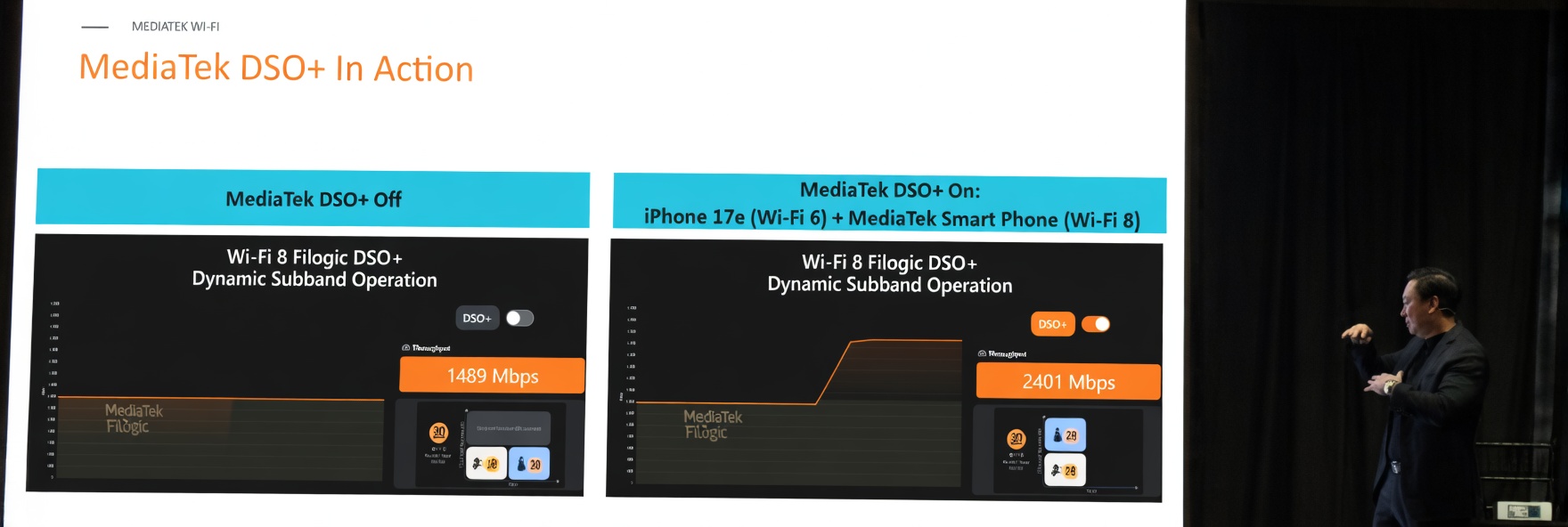
James Chen – Vice President, Wireless Business Unit at MediaTek demonstrated how the company’s Wi-Fi 8 platform has demonstrated its DSO capability, which leverages an ‘old’ Wi-Fi 6 smartphone using an early version of its own Wi-Fi 8 smartphone to get superior throughput. The idea here is that MediaTek Wi-Fi 8 can coexist with older Wi-Fi types to achieve better throughput. He said Wi-Fi 8 isn’t about replacing legacy Wi-Fi—rather it’s designed to work alongside older standards (Wi-Fi 5/6) to boost performance in mixed environments. MediaTek is moving aggressively to accelerate the Wi-Fi 8 shipment timeline. We spoke to a handful of Enterprise Wi-Fi vendors who are seriously considering working with MediaTek in the Wi-Fi 8 era.
James-Chen-MediaTek-at-Wi-Fi-NOW-April-2026
Matt McPherson – Chief Technology Officer, Wireless, Cisco, emphasized using AI will enable better Wi-Fi for Enterprises. The idea is that once AI Inference is available in Wi-Fi Access Points (in the Wi-Fi 8 era), these devices will be able to intelligently update channels and client devices, while at the same time, manage the flow of telemetry both up and down the network. He also explained that collecting all AP/client data into central “data lakes” is unsustainable. This is because storage costs and processing latency make it impractical at scale. McPherson also discussed that using “AI at the Edge,” as a solution, will: “use AI in the Access Point to pre-process data locally,” (e.g., filtering noise, identifying anomalies) and “Ensure APs then interact intelligently with controllers/cloud to share only relevant data (e.g. ‘send security alerts, and report channel congestion.”
Matt-McPherson-Cisco-at-Wi-Fi-NOW-April-2026
Anindya Chakraborty – Senior Vice President, R&D and Products, for RUCKUS Networks participated in a round table, where he made it clear that it’s moving headlong into the AI era for its Enterprise Wi-Fi portfolio. The company is skeptical that Centralized AI (Cloud-based or Controller-based only) will scale to significant levels. It agreed with Cambium that pushing all AI/data processing to the cloud is flawed. The company favors hybrid/distributed models where APs or edge handles real-time tasks such as channel selection and interference mitigation, while the cloud focuses on long-term trends and policy. Generally, the company agrees with Cisco’s edge-enhanced AI viewpoint, recognizing that the industry consensus is forming that cloud-only AI for Wi-Fi operations is inefficient.
Ruckus-and-Cambium-at-Wi-Fi-NOW-April-2026
650 Group researches AI Networking and have held the view that this new Wi-Fi 8 generation will accelerate Campus AI Networking. You may learn more about our views at here.