

by Alan Weckel, 650 Group / October 26, 2026
Introduction
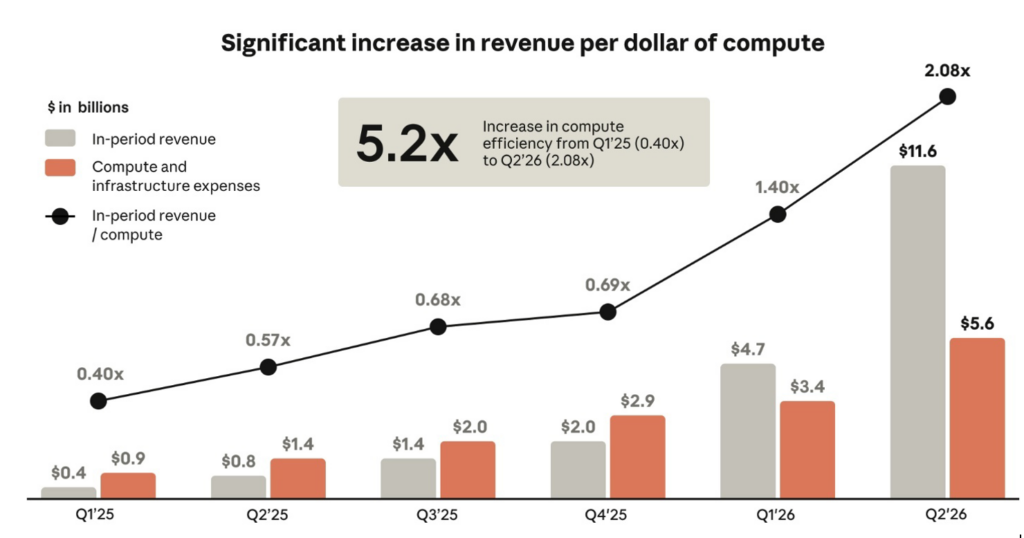
Anthropic’s draft S-1 filing shows the next phase of AI infrastructure revenue and CAPEX spend. First-half 2026 revenue reached $16.3 billion, up from $1.1 billion in the prior-year period. Third-quarter revenue hit $16.8 billion, up 45 percent sequentially. Compute and infrastructure spend in the first half approached $9 billion, more than the full-year 2025 total. These figures sit against multi-year compute commitments that already exceed $450 billion in non-cancellable or take-or-pay cloud agreements and could approach $750 billion once additional deals close. It wasn’t that long ago that contracts from Lyft and Pinterest of $1-3 billion moved the needle; AI spend is a whole different cycle. The IPO will convert this revenue momentum into fresh capital, unlocking the next CAPEX wave across GPUs, XPUs, power, and facilities. Ultimately, within the wave, networking is the fabric that must bind everything together and becomes a bigger part of the CAPEX spend. Without robust networking, capacity remains idle
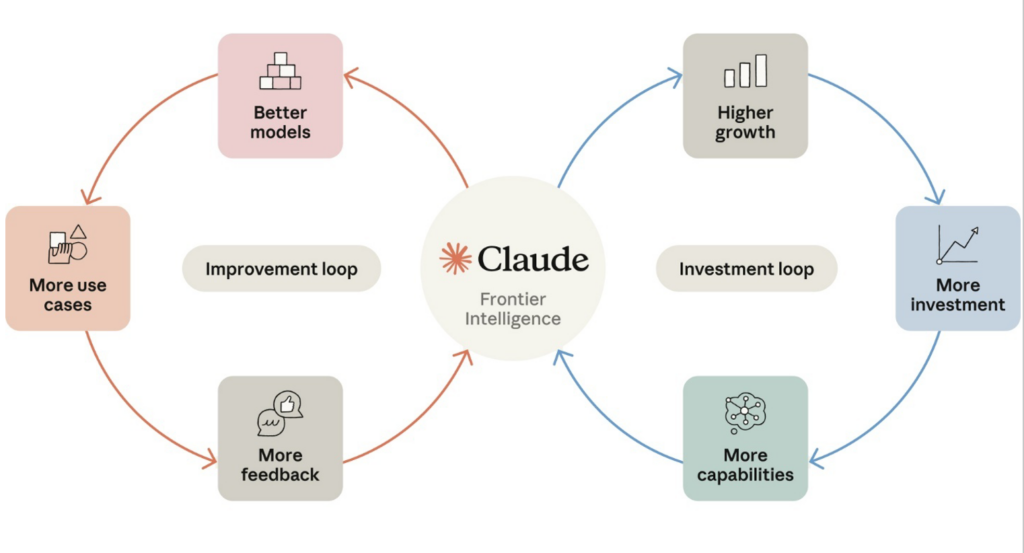
The Self-Reinforcing Loop
Revenue growth funds larger compute contracts. Larger contracts deliver more training and inference capacity. More capacity produces stronger models. Stronger models drive higher usage and revenue. The cycle now runs at a scale that requires the network to act as the real-time glue across heterogeneous suppliers.
Compute Contracts Already Signed
The prospectus lists the major obligations. Google Cloud sits at $111 billion. AWS sits at $110 billion. Microsoft sits at $31 billion. These three agreements run roughly seven to ten years and are payable regardless of actual usage. Broadcom-related equipment leases add approximately $161 billion. Nscale and Lambda together provide up to $86 billion in Nvidia-based capacity through 2033 and 2034. An xAI arrangement can reach $84.5 billion but carries more cancellation flexibility. AMD supplies additional capacity expected to exceed $20 billion alongside an equity commitment. Combined, the visible backlog already exceeds half a trillion dollars and continues to grow. Anthropic has stated that cloud partners have not supplied every gigawatt requested, so the company is also leasing its own facilities and engaging third-party operators.
Why the Network Is the Binding Constraint
These contracts pull capacity from multiple silicon vendors, multiple clouds, and multiple geographies. Google TPUs, AWS Trainium, Nvidia GPUs via Nscale and Lambda, Broadcom custom silicon, and AMD Instinct parts will all sit inside Anthropic workloads. Scale-out Ethernet must move traffic across those racks at 800G and 1.6T. Scale-up domains must keep thousands of accelerators inside low-latency pods. Scale-across links must stitch separate data halls and campuses into one logical training or inference pool. Switch radix, optical reach, and power per bit remain the practical limits. As copper collapses beyond short distances at 224G SerDes, Co-packaged and near-packaged optics, higher-radix silicon, and open scale-up protocols such as ESUN and UALink are the tools that keep utilization high. When the network lags, contracted dollars produce lower tokens per watt and longer training times. When the network keeps pace, the same contracts deliver the full economic value of the CAPEX.
IPO Capital Extends the Wave
The public listing supplies the next tranche of equity that can underwrite additional multi-year take-or-pay deals and facility builds. Each new gigawatt requires matching networking ports, optics, and interconnect silicon. At the volumes already visible, the AI networking market itself is on a path to exceed $300 billion this decade and approach $1 trillion early in the next decade. Anthropic’s contracts simply accelerate that trajectory for every supplier in the stack: switch silicon, optics, cables, and the merchant and custom silicon that sit next to the XPUs.
Conclusion
Anthropic’s numbers confirm that frontier-model economics now rest on multi-year infrastructure commitments measured in hundreds of billions of dollars. The IPO converts revenue momentum into the capital required to keep those commitments growing. The network is the element that turns separate supplier contracts into a single high-utilization fabric. Compute without commensurate networking remains compute left idle. The companies that deliver the ports, optics, and scale-up interconnects that match this CAPEX wave will capture the largest share of the infrastructure spend that follows the listing.
