

Having just returned from MWC 26 in Barcelona, I stopped by the Arrcus booth and learned about the Arrcus Inference Network Fabric (AINF) that the company announced right before the show.
The company describes AINF as the first AI Inference Network Fabric. It is positioned as a carrier-grade, 5G-ready fabric designed to address the demands of real-time and agentic AI applications, with improvements in throughput, power efficiency, reduced token retrieval time, latency, and cost per inference. The announcement highlighted the first public demonstrations of AINF capabilities, following its earlier introduction, with live demos in Hall 2 of the event, alongside related ecosystem announcements and broader AI networking showcases.
I snapped a picture, seen below, of how the AINF architecture could be deployed, including the Policy Aware Inference Router (with features like model registry adaptor, telemetry aggregator, site model load, and policy enforcement on xPU platforms), Peering Routers (supporting front-haul/back-haul overlays, MPLS/SRv6 transport, and traffic-engineered paths on NVIDIA Spectrum/BF3 and Broadcom DNX), and ToR Switches (L2/L3 connectivity, multi-tenancy, SyncE/PTP on NVIDIA Spectrum and Broadcom XGS).
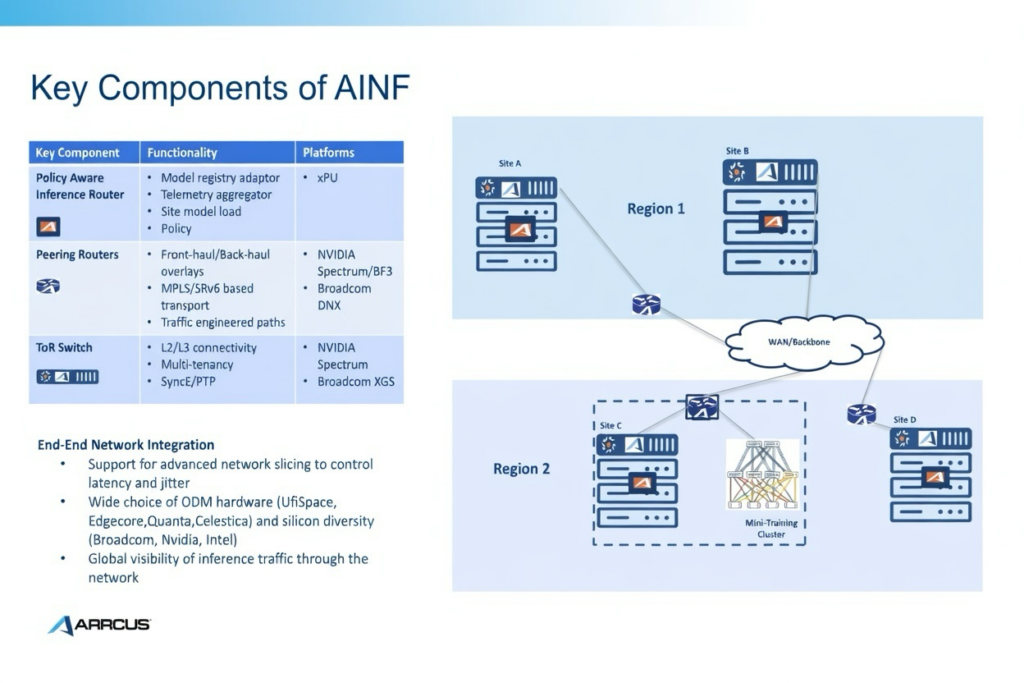
The diagram illustrates a distributed deployment across regions and sites, with end-to-end integration emphasizing advanced network slicing for latency/jitter control, broad ODM hardware support (including UfiSpace, Edgecore, Quanta, Celestica), and silicon diversity (supporting Broadcom, NVIDIA, Intel), plus global visibility of inference traffic.
The AINF architecture aligns directly with the distributed, policy-aware approach that Arrcus is promoting for AI inference workloads.