

by Chris DePuy, 650 Group / October 7, 2026
At the OCP Global Summit, which runs October 12–15 in San Jose (OCP Global Summit), we joined Cisco’s data center team for pre-show analyst sessions with Will Eatherton, SVP of Engineering for Data Center & Internet Infrastructure, and Rakesh Chopra, SVP of Silicon & Systems Architecture and Cisco Fellow. Cisco framed the problem as AI gains compounding faster than infrastructure can scale: briefing slides citing Epoch and NVIDIA data showed GPT-2 trained on a bit more than a hundred GPUs while xAI’s Colossus runs more than 200,000 GPUs for the Grok family, and training compute doubling roughly every five months (Stanford HAI 2025 AI Index). Three commitments followed: turn scale-out into productivity, connect the world’s AI capacity, and open at every layer of the stack (Cisco OCP page).
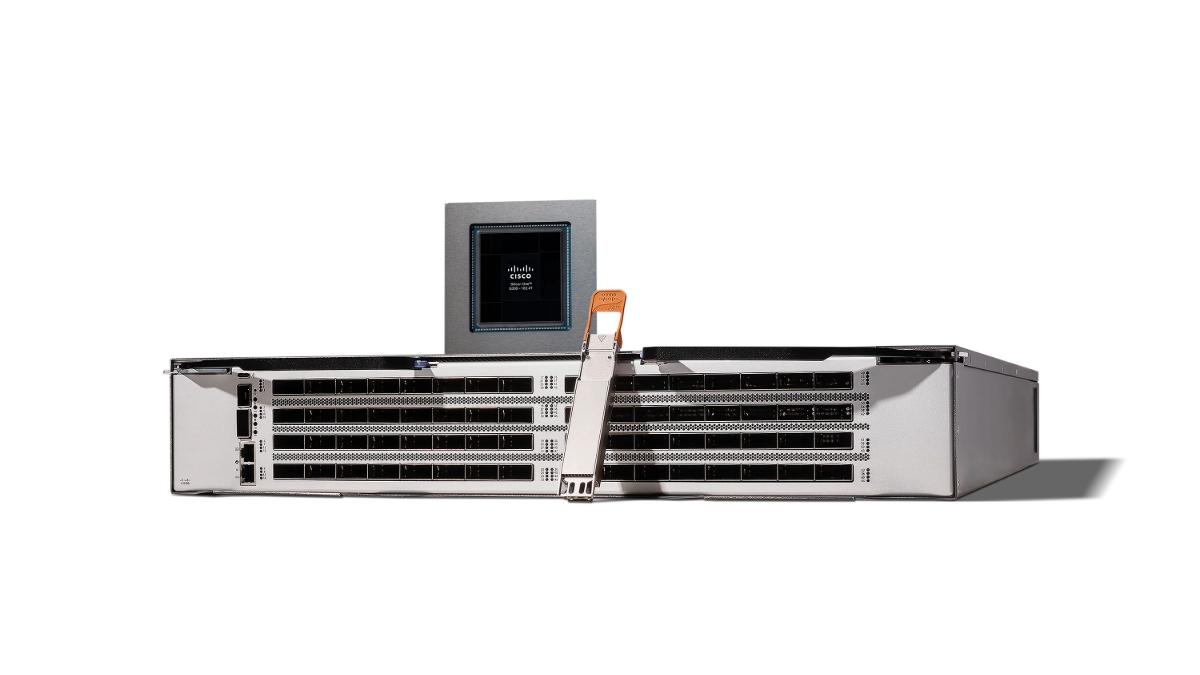
USFP: 400G SerDes in a pluggable. The headline optics news: Cisco and NVIDIA have jointly defined USFP, positioned as the industry’s first pluggable form factor designed for 400G SerDes lanes, with a joint multi-source specification push and the joint announcement set for Monday morning. The form factor runs 200G or 400G SerDes per lane, aggregates 6.4T via 16 lanes and 12.8T via 32 lanes, and carries 4X bandwidth density plus 1.3X power efficiency at 400G SerDes versus 200G, with Amphenol and TE Connectivity in as ecosystem partners. Critically, it stays air-cooled, and the roadmap slides show a 430G-to-1.6T pluggable family on the same form factor. XPO, the liquid-cooled approach Arista’s MSA backs, reaches 12.8 Tbps through a 64-channel module with no 400G entry point (Arista XPO MSA press release). Both camps claim 4X: XPO gets there by resizing the module and adding liquid, USFP by moving to 400G SerDes lanes while staying air-cooled.
The second takeaway: every next-generation pluggable announced to date carries an optical DSP — no linear-drive pluggable has shipped in these lineups — and we expect DSPs inside pluggables for the foreseeable future. XPO’s spec sheet backs this up: it supports linear, half-retimed, or fully-retimed interface architectures (Arista XPO MSA press release), but what ships is DSP-based. That matters to the supply chain: the linear-pluggable disruption story keeps slipping, and buyers should size optical DSP content accordingly.
We think USFP is the low-risk operational bet: it preserves air-cooled flexibility, opens with a 400G-per-lane entry point for brownfield fabrics, and keeps a straight module path to 12.8T, while XPO buys 4X front-panel density for AI factories at the cost of liquid to the front panel (Arista XPO MSA press release) — a real operational fork, since no optic requires liquid today. Both camps have merit, and the market will sort it out over the next several quarters.
On silicon and systems, the G300 (102.4 Tbps) is shipping in first Cisco 8000 AI systems with customer sampling under way (Cisco G300 announcement), the G302 will power the first P200 and T56 G3.2 systems with 1.6T OSFP ports, a G301 rack-edge chip at 51.2T lands in 2026 for high-density 1.6T leaf/TOR, and the A100L-powered Cisco 8001 adds out-of-band management due in 2027. On operations, SONiC comes to Cisco 8000 and N9000 — community, custom, or Cisco-validated builds — with Live Protect runtime vulnerability protection for N9000 in SONiC environments. Demos run at booth #C59 with Microsoft, Alibaba Cloud, AMD, and Supermicro (Cisco OCP page).
650 Group researches several of the technologies we covered in this blog, including Data Center / Co-Location / Cloud, Data Center Interconnect Semiconductor, and more.
