

by Chris DePuy, 650 Group / October 5, 2026
Last week, the White House renamed artificial intelligence. On September 29, President Trump signed the executive order Inaugurating the Era of Super Intelligence, which directs every executive-branch agency to write “Super Intelligence” or “SI” in place of “Artificial Intelligence” or “AI” in official correspondence, websites, reports, and policy documents, and to retire the old terms from government use. The order keeps the legal definition of SI equal to the existing statutory definition of AI for now, and it tasks the president’s science adviser with proposing a new federal definition. Trump unveiled the change while launching America.gov, the administration’s new AI-powered federal services website, at Washington, DC’s Andrew W. Mellon Auditorium. As 650 Group (https://www.650group.com) has been tracking in its AI infrastructure research, terminology follows capital, and the practical effect of this order is that agency solicitations, standards work, and budget lines will progressively carry the SI label even though the underlying technology definition is unchanged.
The same day, after a White House luncheon, the president and six tech executives signed the White House Accord on Super Intelligence, which Trump described as “morally binding” and which carries no legal enforcement mechanism. Google’s Sundar Pichai, Anthropic’s Dario Amodei, Meta’s Mark Zuckerberg, OpenAI’s Greg Brockman, Nvidia’s Jensen Huang, and SpaceX’s Elon Musk signed. Amazon’s Jeff Bezos and Palantir’s Alex Karp attended but did not sign, and House Speaker Mike Johnson joined along with Cabinet members. The accord commits each company to four layers of controls and audits: internal controls covering cybersecurity, biosecurity, and chemical threats; an internal team verifying that monitoring works as intended; an independent external assessment; and a board oversight committee to receive the reports. The document misspelled “United States” as “Unites States” under the president’s signature, an error that drew wide mockery, including from California Governor Gavin Newsom.
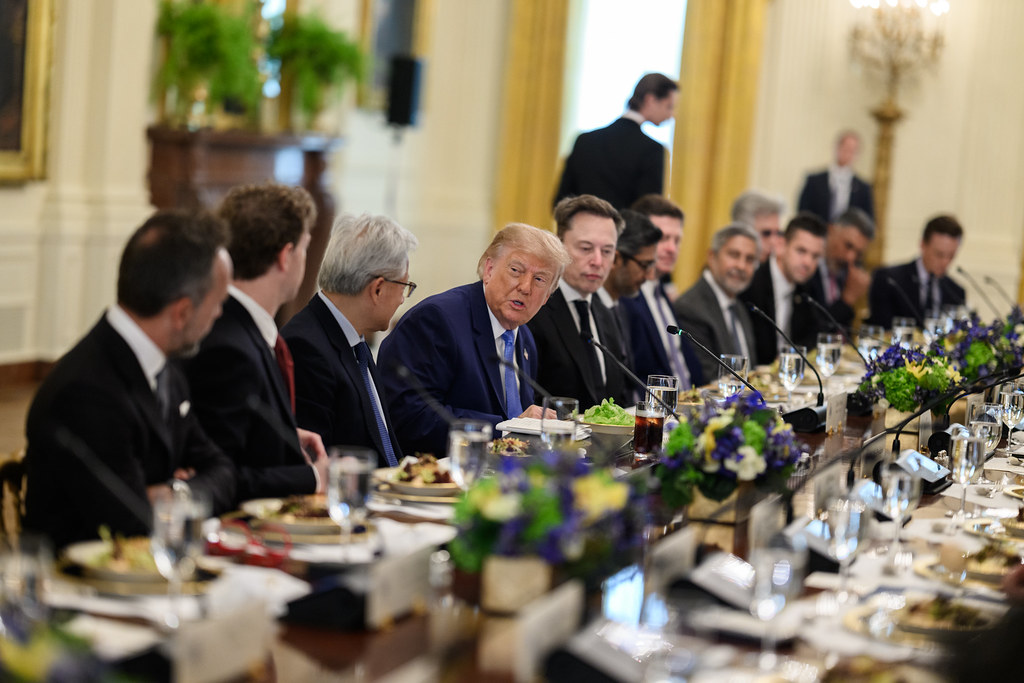
We think the more consequential story is what the accord omits rather than what it contains. There is no enforcement mechanism, no independent regulator, and no mandatory reporting timeline, only a commitment to “meet regularly” on standards. That outcome follows from the president’s stated position: he has called concerns about AI risk a hoax, while Anthropic’s Amodei and OpenAI’s Altman have separately called for independent testing and government-set rules. We were especially interested in the contrast between the voluntary accord and the terminology mandate, because the order compels language change across government while leaving model oversight voluntary — a trade-off, not a settled oversight policy. For buyers, the signal is that US frontier-model policy will likely remain industry self-policing for now.
Elon Musk moved fastest on the terminology. On October 4 he wrote “No more AI” on X, calling the super intelligence label “better,” and when asked whether the company would take the SpaceXSI name he replied “Yes, we will make that change”, adding that “SpaceX is a super intelligence company.” The SpaceXAI unit spans Grok, the X platform, and the Colossus computing cluster. As of October 4, Musk announced the change but did not execute it, and the company’s website and social accounts still said SpaceXAI. We think the rename is more than a courtesy to the White House: it positions the combined SpaceX and SpaceXAI entity as a super intelligence supplier in the same government market the order just renamed, and competitors will face the same naming pressure in RFPs and public-sector bids.
No other major company announced a rename by October 5. Instead, companies are securing the branding quietly: registrations of “.si” domains rose more than 2,100 percent in September to 44,000 new web addresses, per Slovenia’s registry, a surge the BBC reported. Domain purchases change no product names, but they show how fast the market prices a government naming mandate.
Government machinery moved with the order. On October 4, Trump announced the Super Intelligence Force, which coordinates the federal government’s engagement with consumers, public interest groups, religious organizations, infrastructure providers, and industry. Director of National Intelligence Jay Clayton leads it, joined by FTC Chairman Andrew Ferguson, Under Secretary of Defense for Research and Engineering Emil Michael, and OPM Director Scott Kupor, reporting to Trump and Chief of Staff Susie Wiles. The SIF is the renamed successor to the “AI Force” Trump proposed on September 19, and its first test will be whether the accord’s four layers of controls become a de facto expectation in federal procurement.
The renaming will show up first in federal solicitations and budget documents, then in vendor marketing, and eventually in the vocabulary of enterprise buyers who follow government language. Under the administration’s Genesis Mission, more than $5 billion has been announced to harness Super Intelligence for science, medicine, energy, and manufacturing, so the dollars behind the new name are real. If we were a competitor selling into federal AI programs, we would treat SI language as a requirement in our proposals this quarter rather than a debating point. 650 Group researches several of the technologies we covered in this blog, including AI Networking, AI Servers, and more.
