

Networking stands as the heart of AI factories. In my recent fireside chat with NVIDIA SVP of Networking Gilad Shainer, we examined the rapid architecture shifts as the industry enters the 800G upgrade cycle. Bandwidth explodes, scale-out ramps, and the 800G market surges in size. We project the 800G market for Ethernet Switching and NICs will exceed over $50B in 26/27 with nearly 200M ports shipped during that time. Spectrum-X Ethernet emerges as the AI-first, purpose-built fabric that eliminates the bottlenecks general-purpose networks create for AI.
AI Networking is About Multiple Fabrics Enhancing Every AI Factory
AI factories require specialized networking infrastructures.
Scale-up connects multiple GPUs into single massive units. NVIDIA grew this from 8 GPUs to 72 today and targets 576, then 1152 and beyond. For NVIDIA, NVLink supplies extreme bandwidth, ultra-low latency, and in-network compute that creates true super GPUs.
Scale-out connects these building blocks. For NVIDIA, this is Spectrum-X Ethernet, which includes Spectrum Ethernet switches, and ConnectX SuperNICs. Spectrum-X Ethernet eliminates jitter and delivers 95% effective bandwidth with zero collisions across hundreds of thousands of GPUs.
Scale-across links multiple factories into giga-scale systems with distance-aware congestion control within a single metro or across even longer distances.
AI-first Ethernet Delivers Zero-Jitter and 95% Effective Bandwidth
Gilad made it clear that AI networks demand a complete end-to-end stack of switches and SuperNICs. Operators cannot succeed with a switch alone or a NIC alone. Spectrum-X achieves deterministic performance with zero jitter and 95% effective bandwidth in live deployments. As bandwidth demand climbs vertically, the industry now ships more networking capacity in a single quarter than in the entire prior year.
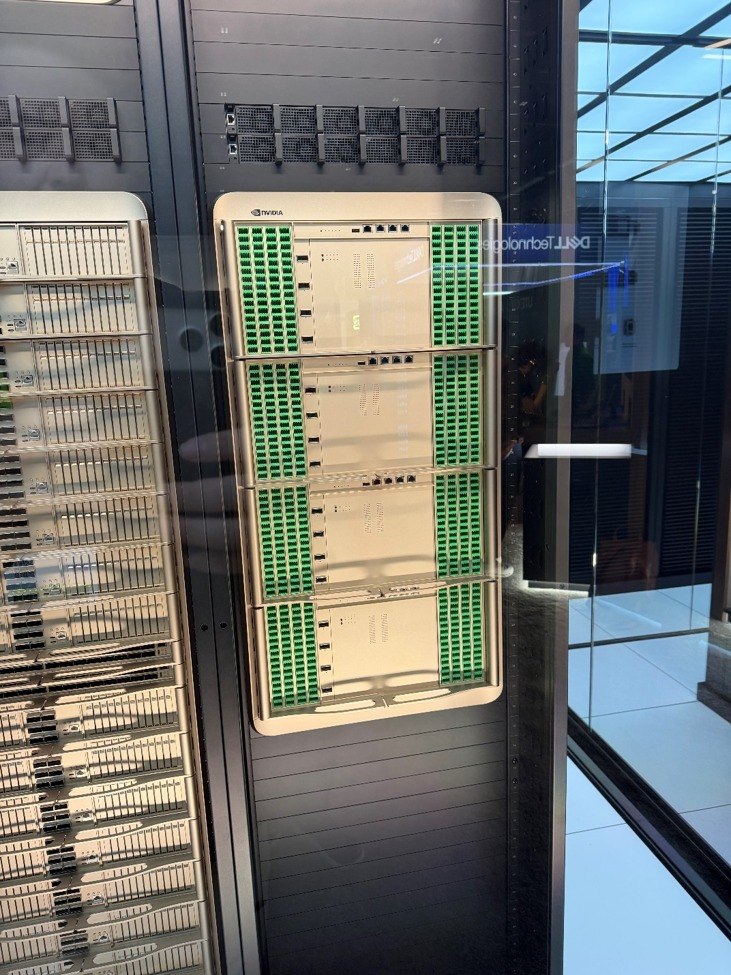
Co-Packaged Optics (CPO) Entered Production and Cuts Power Nearly 5x
Optical connectivity power already nears 10 percent of the total AI factory and can increase further if additional networking tiers are needed. CPO places optical engines directly with the switch silicon. This reduces optical network power consumption by nearly 5x and increases mean time between interrupts by 10x. Reliability and efficiency advance together. The design enables large radix, long reach, and high robustness through advanced packaging and partner collaboration. Power efficiency ranks as the top constraint in AI factories. CPO plus liquid cooling returns more energy to compute where it generates value and accelerates results for operators. CPO in scale-out also sets the industry up for success when CPO enters the scale-up market.
Ethernet Extends Dominance With Scale-Across
Spectrum-X Ethernet has also entered the DCI/Scale-Across domain as AI factories expand beyond a single site. The gap between purpose-built AI networks and off-the-shelf Ethernet continues to widen. Innovation now runs on an annual cadence with multiple generations in parallel development. Spectrum-XGS Ethernet extends the platform across data centers and continents to form unified giga-scale super factories. Large foundational model builders already deploy Spectrum-X Ethernet at a massive production scale. These deployments prove the platform as the foundation for the next wave of AI infrastructure growth.
Conclusion
Networking determines AI factory success or failure. NVIDIA Spectrum-X Ethernet, with its AI-first design, is helping operators build robust fabrics that raise the GPU utilization. This leads to lowering costs while unlocking true giga-scale token generation capabilities. Advancements in CPO and breakthroughs in CPO further unlock the fabric’s capabilities and reach.