

This morning, Arm positioned the new Mali G2-Ultra NX GPU as its first AI-native Mali graphics core, integrating dedicated neural accelerators directly into the shader pipeline rather than bolting an NPU alongside it. It arrives with a third-generation ray tracing unit and a new execution engine Arm calls the largest Mali instruction-set upgrade in seven generations, with up to 2x more registers per warp.
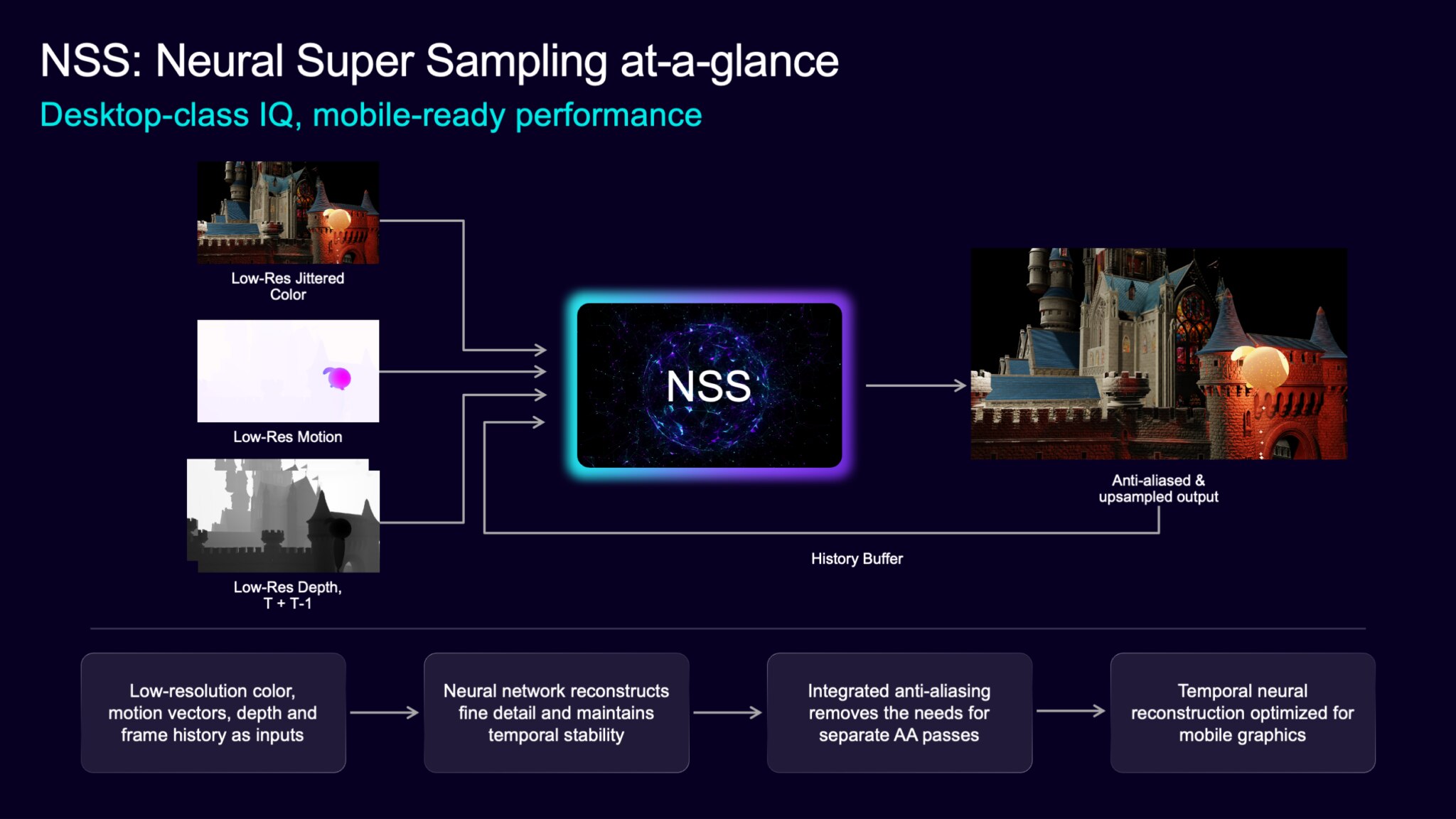
The neural work is where the architecture earns its name. Three integrated features — Neural Super Sampling, Neural Frame Rate Upscaling, and Neural Super Sampling plus Denoising — shift reconstruction, frame generation and denoising onto the GPU’s neural units, as Arm describes in its Mali G2-Ultra NX deep dive. In its Neural Dawn demo with Sumo Digital, Arm reports up to 4x higher performance efficiency and up to 70 percent lower external memory traffic versus native rendering, which is what makes techniques like Unreal Engine MegaLights practical on a phone. Opacity Micromaps raise frame rates by 30 percent in one Arm ray-traced demo while cutting the ray tracing workload up to 70 percent.
We think the announcement matters less for the raw gains — up to 24 percent benchmark and 14 percent non-AI gaming uplift, per Arm’s Mali G2-Ultra NX deep dive — than for what it signals about where AI dollars migrate. As mobile becomes the largest AI compute endpoint, Arm is moving neural processing into the graphics pipeline, down the efficiency-critical path that determines sustained frame rate and battery. That is a structural shift for the mobile GPU market and the merchant semiconductor vendors that serve it.
650 Group researches several of the technologies we covered in this blog, including Data Center / Co-Location / Cloud and Home / Residential / Consumer infrastructure.
Related reading:
- Mixture of Experts and Disaggregated Architectures Are Rewriting the Rules of Network Infrastructure
- Full Stack Security and AI Job-ID-aware Segmentation: Cisco Raises the Bar for AI Fabric Efficiency
- Networking is the Key to Unlocking GPU/XPU Diversity
