

by Chris DePuy / July 19, 2026
Fortinet announced new capabilities for its FortiEndpoint unified endpoint platform this week, designed to address a problem nearly every enterprise IT team is now grappling with: how to manage and secure the explosion of AI applications and agents running on employee endpoints. The innovations, detailed in the company’s press release, are delivered through the existing FortiEndpoint agent — one agent, one console, one license — covering AI visibility and control, native data loss prevention, and endpoint risk scoring. The company said its threat intelligence division’s 2026 Global Threat Landscape Report highlighted that attackers are accelerating their use of sophisticated techniques to exploit gaps across users, devices, applications, and data, making the timing of these features notable.
The announcement surfaced a common tension we hear from security teams: AI adoption is happening whether IT sanctions it or not. Employees are installing AI agents and using web-based AI tools, often without visibility from their security operations center. FortiEndpoint’s new AI visibility module lets organizations see exactly which AI applications and agents are in use across endpoints — installed applications, agents, and web-based tools — from a single view. Integrated DLP capabilities allow security teams to set granular guardrail policies around what data those tools can access, reducing sensitive data exposure and the risk of unauthorized tool usage. Michael Xie, Fortinet’s founder, president, and CTO, described the approach as extending the Fortinet Security Fabric strategy by consolidating security, secure access, data security, AI visibility, and assisted operations into a single endpoint platform.
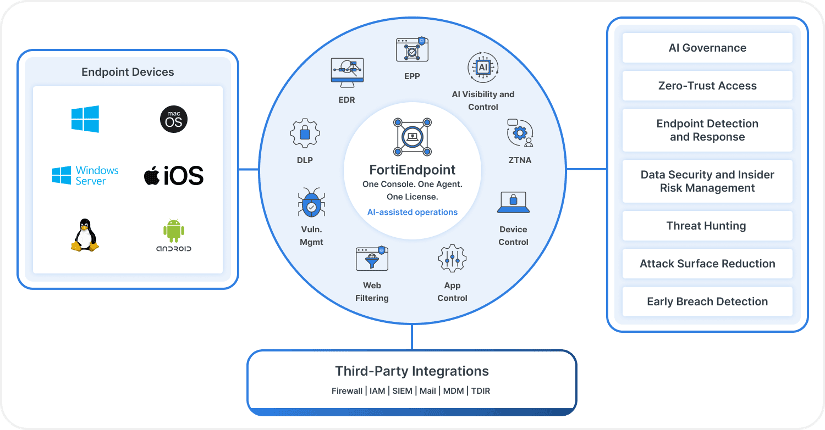
As 650 Group (https://www.650group.com) has been tracking in its cybersecurity research covering Corporate Endpoint Security, SASE, and the broader SSE and ZTNA markets, the endpoint is becoming one of the most contested surfaces in enterprise security. The agent population on an average enterprise endpoint has grown substantially, and the addition of AI agents introduces a whole new category of risk that existing endpoint and data security tools were not designed to manage. Fortinet’s consolidation approach — folding AI governance, DLP, and endpoint risk scoring into a single agent already deployed on millions of endpoints — is a direct response to this fragmentation, and we think it reflects a pragmatic view of where the market is headed.