

by Chris DePuy, 650 Group / September 30, 2026
Today, we attended HPE’s Networking Investor Day, where the company put numbers on its post-Juniper networking strategy — and, the same morning, backed the story with its first AMD Helios AI Rack order, a $1.2B deal with Vultr. The through-line of the day was that AI is re-rating the network: HPE’s investor day release frames the network as more strategic in the AI era, and the company attached growth targets, margin targets, and a proof point to that claim.
Rami Rahim, President and GM of HPE Networking, gave an update on the Juniper acquisition and HPE Networking more generally. The sales organizations were combined in six months — ahead of plans, per Rahim’s remarks at the event. HPE also lifted its Juniper-related cost synergy goal to $800M of annual run-rate savings by fiscal 2028’s close, an increase from the earlier target of $600M.
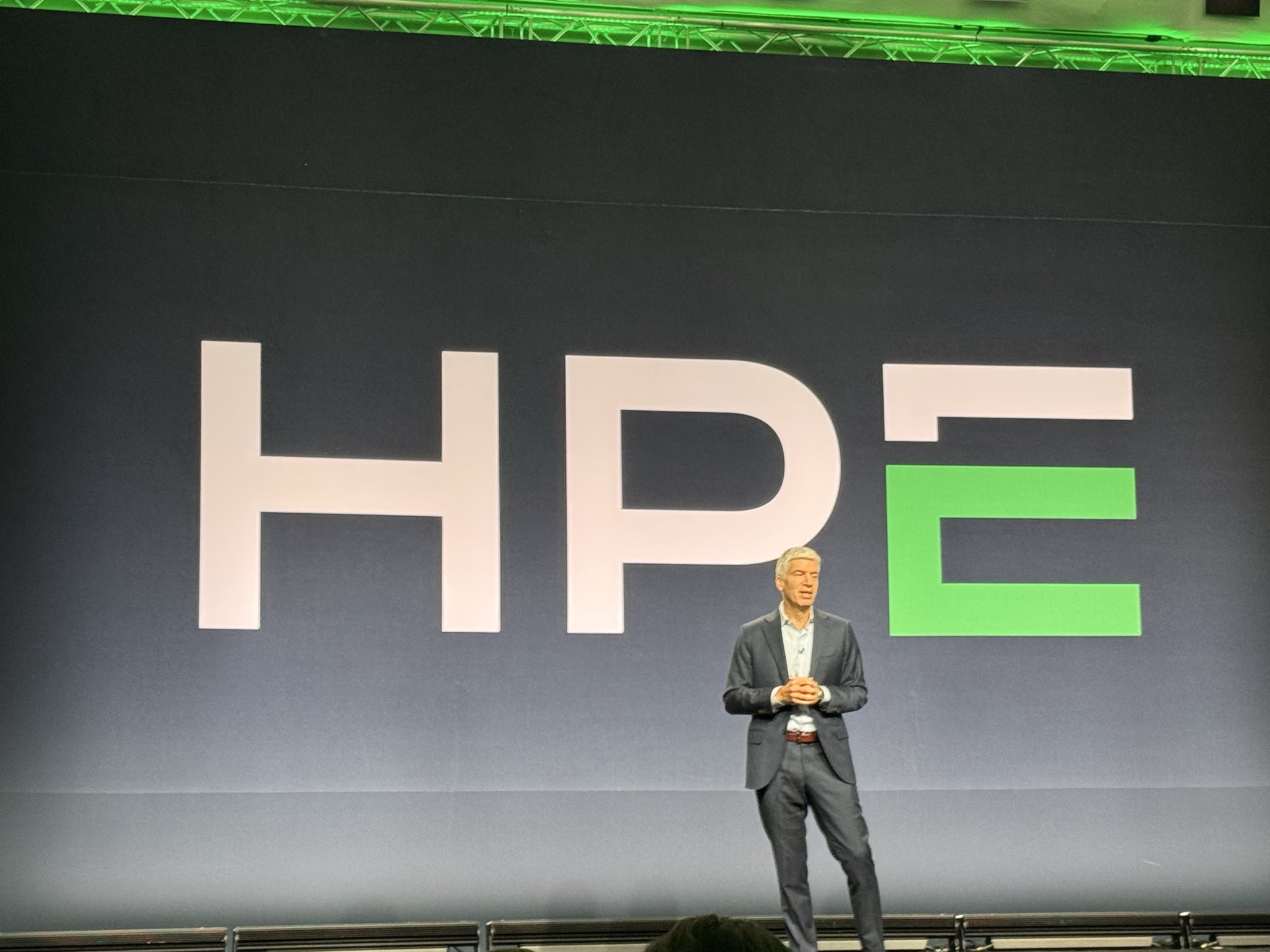
Photo: Rami Rahim at HPE Networking Investor Day (source)
Category growth targets through fiscal 2029. HPE outlined revenue growth expectations for each of its networking product categories. In Data Center Networking — where AI is reshaping data center architectures and high-performance networking keeps GPUs from stalling on latency, congestion, and instability — HPE puts revenue on a path that compounds in the 50s percent range annually, low end to high end, through fiscal 2029. Routing, the company said, should post a CAGR in the low-to-high 20s percent range over the same period, leaning on decades of routing incumbency and the MX and PTX platforms, which run on Trio and Express silicon. Campus & Branch, per HPE, sits at the start of a wide-ranging, multi-year refresh cycle built around Wi-Fi 7, with high single-digit annual growth expected through fiscal 2029 — Security, likewise, is expected to expand at a high single-digit annual rate as HPE embeds SASE, network access control, firewalls, and identity-based policy enforcement throughout the network. HPE believes it will outpace the market rates it laid out and pick up share in Data Center Networking and Routing as well as Campus & Branch over the coming three years.
Financial outlook raised. For fiscal 2027, HPE now guides the Networking segment to revenue growth in the high-teens to low-20s percent band, with segment operating margin in the 25%–29% region. Beyond FY27, management projects segment revenue compounding at a high-teens percent rate between fiscal 2026 and fiscal 2029, and holds a mid-to-high 20s percent operating margin objective for fiscal 2027 through fiscal 2029. Heading into FY27, HPE had already doubled its networking supply purchase commitments quarter-over-quarter during the third quarter of its fiscal 2026 — a move aimed at meeting strong demand while cushioning supply limits. We think the most consequential figure in the set is the Data Center Networking CAGR — it implies HPE sees the scale-up and scale-out switching market expanding fast enough to pull the whole segment’s growth rate into the high teens.
The $1.2B Vultr order as proof. The investor day coincided with the company logging its first system order: the AMD Helios AI Rack, built by HPE, drawing $1.2B in business from Vultr, the largest privately-held cloud infrastructure company in the world, which will stand the racks up in its US data centers. Every rack carries 72 AMD Instinct MI455X GPUs alongside EPYC CPUs, Pensando AI NICs, and ROCm software, tied together by six QFX5252 scale-up Ethernet switch trays from HPE Juniper Networking in every rack over standards-based Ethernet that supports UALink over Ethernet (UALoE). The win follows roughly three years of cooperation between Vultr and Juniper Networks, and HPE Services is handling deployment and liquid cooling. We think the notable signal here is the networking attach: an AI rack win that leads with Juniper-built scale-up Ethernet switching validates the open, Ethernet-based scale-up approach that 650 Group has been tracking in its AI networking research, and it puts HPE Networking inside the AI compute rack rather than beside it.
Taken together, the day made the case that the Juniper acquisition is converting into AI-era growth economics — raised synergies, raised segment guidance, and an AI-rack order that monetizes networking inside the compute. 650 Group researches several of the technologies we covered in this blog, including Data Center Networking, AI Networking, and Campus and Enterprise Networking.
