

by Chris DePuy, 650 Group / October 20, 2026
SpaceX (Nasdaq: SPCX) reported third quarter 2026 results this afternoon. Revenue reached $14.6 billion, up 161% year-over-year, and the Super Intelligence segment swung to a positive $431 million of operating income. We think the quarter confirms two virtuous cycles: the launch business running near break-even while the constellation it deploys earns billions in Connectivity, and SI profitability arriving just as the company lifts its capital spending to $16,444 million for the quarter. SI is the segment formerly reported as Artificial Intelligence, the former xAI business that merged with SpaceX in February, as we covered at the time, and it took the Super Intelligence name after the White House renamed AI in a September executive order.
How did SpaceX perform in Q3 2026?
The quarter ended September 30, 2026 produced revenue of $14.6 billion, income from operations of $2.8 billion, net income of $4.4 billion, and Adjusted EBITDA of $8.8 billion, up 306% year-over-year, per the company’s release. The segment detail is where the two cycles show up, and we think it is the most useful way to read the release:
| Segment (quarter ended September 30, 2026; $ in millions) | Revenue | Income (loss) from operations | Capex | Source |
| Space | $1,767 | $(7) | $1,606 | SEC 8-K |
| Connectivity | $5,248 | $2,367 | $1,543 | SEC 8-K |
| SI | $7,560 | $431 | $16,444 | SEC 8-K |
| Total | $14,575 | $2,791 | $19,593 | SEC 8-K |
Which segment matters most depends on the reader: broadband operators and LEO watchers should watch Connectivity’s margin structure, data center equipment vendors and cloud builders should watch SI’s capex and its cloud services agreements, and launch customers should note Starship’s first revenue flight. We think the two cycles connecting the segments — space infrastructure enabling communications profits, and SI profits reinforcing compute capex — are the story of the quarter.
Space: $(7)M of Operating Income While Starship Turns Revenue-Generating
Space revenues were $1,767 million for the quarter ended September 30, 2026, up 84% sequentially and 6% year-over-year, while the segment posted a $(7) million loss from operations against a $259 million profit a year ago. The company attributed the swing to accelerating Starship research and development: Space segment R&D rose to $1,225 million from $849 million a year ago, and total segment costs and expenses grew $367 million year-over-year, per the release. The company logged 12 customer launches among 35 total launches in the quarter, including NASA’s mission carrying the Nancy Grace Roman Space Telescope, and signed three commercial Starfall missions, 18 National Security Space Launch missions, and three additional NASA ISS Crew missions to its pipeline.
The quarter’s structural event was Starship Flight 14, the company’s first orbital Starship flight and its first revenue-generating Starship mission, which delivered 26 Starlink V3 satellites to the broadband constellation. The company stated the flight added roughly 10x the downlink capacity of a Falcon 9 Starlink launch. SpaceX also announced Starbase, Louisiana, a planned spaceport intended to host thousands of Starship flights annually, with a first launch targeted for 2029. We think this is the front end of the first cycle: the Space segment absorbs Starship development at roughly break-even, and the satellites those rockets deploy convert into Connectivity revenue with no corresponding launch revenue recognized, since internal Starlink launches sit inside the Space segment at cost.
Connectivity: $2.4 Billion of Operating Income on $5.2 Billion of Revenue
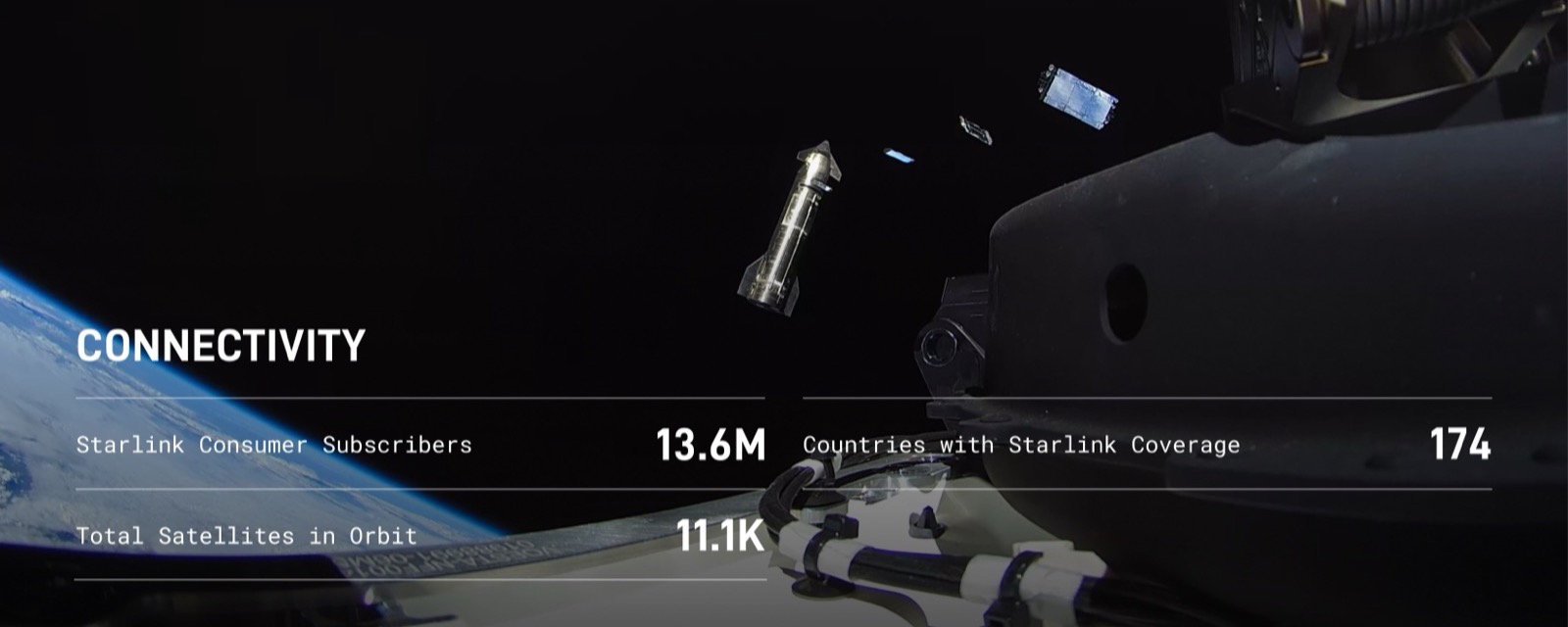
Connectivity revenues were $5,248 million in the quarter, up 22% sequentially and 69% year-over-year, and segment income from operations grew 99% year-over-year to $2,367 million for the quarter ended September 30, 2026. Consumer revenues of $3,121 million grew 57% year-over-year while enterprise and government revenues of $2,127 million grew 91% year-over-year, a mix we think matters because enterprise and government adoption carries longer contract durations than consumer plans. The company reached 13.6 million Starlink consumer subscribers as of September 30, 2026, up 1.6 million sequentially from 12.0 million and up from 7.2 million a year ago, with enterprise subscribers beyond that count reaching into the hundreds of thousands. Consumer ARPU rose 5% from the prior quarter to $69 per month, though it remains below the $83 reported a year ago, a reminder that subscriber growth is still running ahead of pricing. The company also surpassed 3,800 aircraft equipped with Starlink, and subsequent to quarter-end it agreed on October 8, 2026 to acquire low-band 800 MHz licenses covering as much as 14 megahertz paired nationwide, with closing anticipated in the first half of 2027, advancing its Starlink Mobile strategy for direct 3GPP terrestrial service, a progression we have tracked since T-Mobile’s data-over-Starlink announcement.
SI: First Profit Reinforces a $16.4 Billion Quarterly Capex Program
SI revenues were $7,560 million in the quarter, up 195% sequentially and 830% year-over-year, driven by newly activated cloud services agreements, the Cursor acquisition, and growing Grok adoption, per the company’s release. SI income from operations of $431 million absorbed $1.2 billion of share-based compensation tied to the Cursor acquisition, and Segment Adjusted EBITDA reached $4,953 million for the quarter ended September 30, 2026. Nameplate compute reached 1.7 gigawatts as of September 30, 2026, up from 1.4 gigawatts at June 30 and 0.6 gigawatts a year ago, as the buildout of the company’s COLOSSUS II infrastructure continued, and the company introduced Grok Bot, an always-on agentic SI system. SpaceX completed the Cursor acquisition on August 14, 2026 at a $60 billion implied equity value ($42.5 billion of GAAP purchase consideration), and Cursor added $608 million of revenue from closing through quarter-end.
The capex line is where the second cycle lives: SI capex was $16,444 million in the quarter ended September 30, 2026, up from $4,760 million a year ago, and total company capex reached $19,593 million versus $6,880 million a year ago. The spending sits on a funded footing — the company held $51,294 million of cash and cash equivalents plus $38,561 million of marketable securities as of September 30, 2026, its IPO generated $85,675 million of net proceeds in the first nine months of 2026, and operating cash flow for those nine months was $13,097 million. We think the cloud services agreements are the key structural detail: the company cited a growing pipeline of SI infrastructure capacity for third-party customers, which we read as the buildout shifting from speculative toward contracted supply, consistent with the $1T data center capital spending trend we described when the combination was announced.
Two Cycles, One Quarter
The first cycle runs from launch to broadband. Space, at a $(7) million operating result, carries the Starship R&D and internal launch cost behind the 26-satellite Starlink V3 delivery that added roughly 10x a Falcon 9 Starlink launch’s downlink capacity, and the same constellation shows up as $2,367 million of quarterly Connectivity operating income. As the constellation compounds, we expect continued pressure on terrestrial broadband economics in lower-density markets, a share shift we have tracked in our LEO broadband research, and with the 800 MHz agreement the same LEO footprint is now pointed at direct 3GPP competition with mobile operators. The second cycle runs from SI income back into SI capex: a segment now generating $4,953 million of quarterly Segment Adjusted EBITDA is reinforcing a $16,444 million quarterly capital program, and we think that combination — profitability plus contracted cloud capacity — makes the compute buildout more durable than when SI was losing $(1,722) million a year ago. 650 Group researches several of the technologies we covered in this blog, including Data Center / Co-Location / Cloud, Home / Residential / Consumer, and more.
