

by Alan Weckel, 650 Group / October 5, 2026
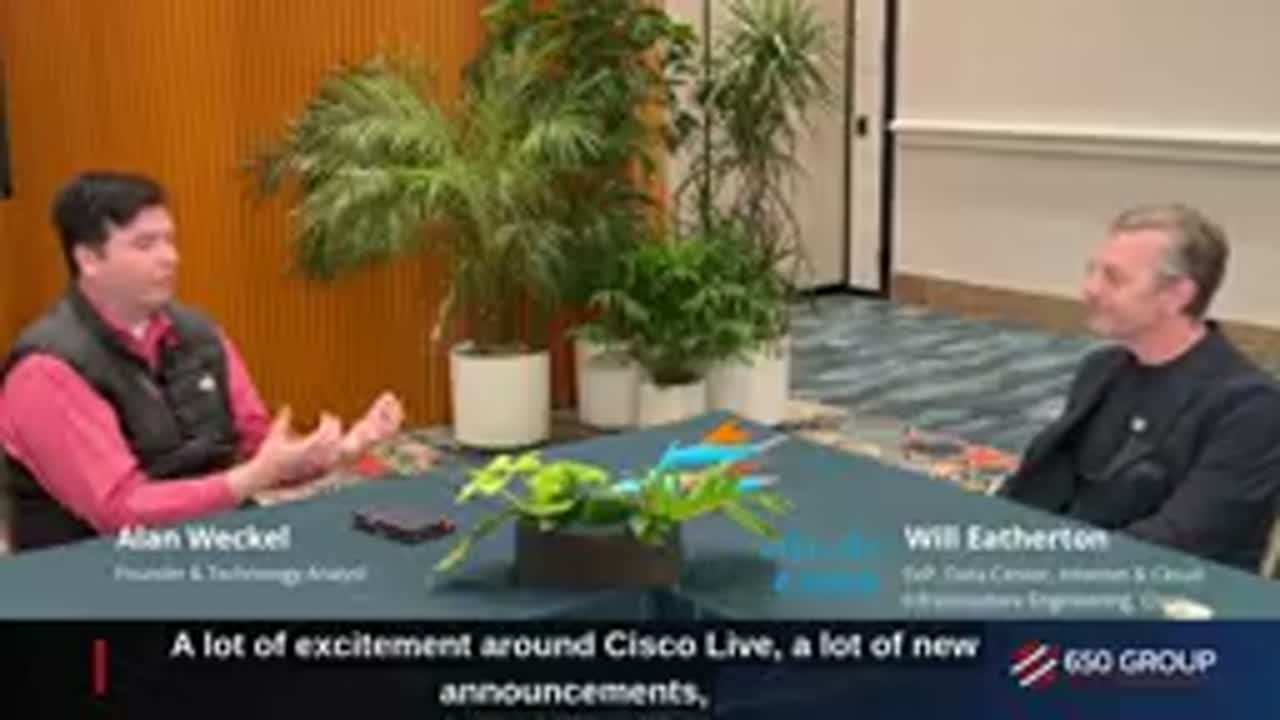
The full interview between 650 Group’s Alan Weckel and Will Eatherton, SVP of Data Center, Internet & Cloud Infrastructure Engineering at Cisco, went up on the 650 Group YouTube channel a few months ago. It was such an interesting conversation that we felt it was worth putting to text, even as the months have passed. The discussion centered on how AI backend network fabric design is changing as AI clusters move from architecture discussions to real deployments: fabrics that once followed a simple scale-out recipe now carry scale-up, scale-across, and storage handoffs on the same Ethernet infrastructure. The interview was recorded at Cisco Live, where Cisco announced Cisco Cloud Control and new secure infrastructure work alongside its data center switching portfolio. With the OCP show coming up, we look forward to seeing Cisco at OCP and learning what’s transpired since Cisco Live in this fast moving market.
One fabric, many levels of opinionation
Speaking at a Cisco analyst briefing ahead of its OCP sessions, Eatherton described a portfolio deliberately spanning three levels of customer control: reference architectures that prescribe switch models and configurations, SONiC as an open option (Cisco ranks among the top contributors and offers it on the 8000 series and, short term, as an option on Nexus), and Nexus Hyperfabric for buyers who want the fabric “opinionated” end to end, down to optical wiring plans. The trade-off he drew between flexibility and an it-just-works design is, in our view, the central decision every AI backend network fabric buyer now faces. A modest small cluster, he noted, “might have a thousand fiber optic cables,” which is why wiring verification against original design intent has become a product feature rather than a service engagement.
The simple scale story is over
Twelve months ago, Eatherton observed, many buyers believed the next few years had “clarified” — scale-up “was all going to be NVLink or equivalent, and that was going to be the end of the story.” That clarity is gone. He walked through a prefill-to-decode pipeline in which an in-progress KV cache is handed from GPU to accelerator, potentially staged to storage over NVMe over Fabric, multiplying the interfaces and the amount of Ethernet in the rack. He also flagged a generational lock-in issue enterprises weigh: NVLink works only within its generation, while 100-gigabit Ethernet interworks across generations — one reason the move from InfiniBand to Ethernet has made AI fabrics friendlier to enterprise customers consolidating off Fibre Channel.
What it means
We think the interview supports two conclusions for AI backend network fabric planning. First, Ethernet’s programmability is doing real work: it lets one fabric serve multiple accelerators instead of a unique network per generation. Second, fabric management — wiring, intent verification, and a common API layer like Cloud Control — is becoming the differentiator as cluster designs multiply. The full interview covers GPU utilization, testing, and interoperability as well. Both topics sit inside 650 Group’s research and reports coverage. 650 Group researches several of the technologies we covered in this blog, including AI Servers, Data Center Switches, and more.
